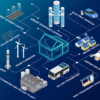
Deep learning is having a moment. There was a time where we could only dream of partially autonomous vehicles and voice-activated assistants. Today, however, these inventions are a regular part of our lives. A subfield of machine learning (ML) and artificial intelligence (AI), deep learning algorithms are designed to learn like a human brain. Deep learning continually analyzes data using an advanced technology known as “artificial neural networks,” which are operated by a series of algorithms that can perceive complex relationships in data sets. These neural networks allow computers to see, hear, and speak—it is the reason we can talk to our phones and dictate emails to our computers.
Algorithms have always been part of the digital world, where they are trained and developed in perfectly simulated environments. The current wave of deep learning facilitates AI’s leap from the digital to the physical world. While the applications are endless—from manufacturing to agriculture—there are still challenges of accuracy, clean data, and reinforcement learning.
Deep Learning in the Real World
AI researchers are working to introduce deep learning to our physical, three-dimensional world. Experts anticipate that deep learning will advance several sectors over the next few years, including:
- Self-Driving vehicle capabilities: The handling of novel situations is the main problem for autonomous vehicle engineers. With growing exposure to millions of scenarios, a deep learning algorithm’s regular cycle of testing and implementation ensures safe driving. Global industry growth for autonomous cars is 16% a year. The global autonomous vehicle market reached nearly US$106 billion in 2021, and one forecast projects it will grow to US$2.3 trillion by 2030.
- Fraud news detection and news aggregation: Deep learning is heavily utilized in news aggregation, which attempts to tailor news to consumers’ preferences. Reader personas are defined with greater complexity to filter out content based on a reader’s interests, as well as geographical, social, and economic factors. Furthermore, there is always room for improvement in filtering out fake news and misinformation.
- Natural Language Processing (NLP): One of the most challenging things for computers to learn is how to comprehend the complexity of human language, including its syntax, semantics, tonal subtleties, expressions, and even sarcasm. The global market for Natural Language Processing (NLP) is expected to reach US$25.7 billion by 2027.
- Healthcare: Some of the deep learning projects gaining traction in the healthcare industry include assisting with the quick diagnosis of life-threatening diseases, addressing the shortage of qualified doctors and healthcare providers, and standardizing pathology results and treatment plans. By 2026, artificial intelligence has the potential to save the clinical healthcare business more than US$150 billion.
Getting “Data-Centric AI” with Deep Learning
Andrew Ng is among the pioneers of deep learning and, according to Fortune, he’s also one of the most thoughtful AI experts on how real businesses are using the technology. Ng has become a champion for what he calls “data-centric AI.” Ng believes developers and businesses should be asking questions like: What data is used to train the algorithm? How is it gathered and processed? How is it governed?
Data-centric AI is the practice of “smartsizing” data so that a successful system can be built using the least amount of data possible. If data is carefully prepared, a company may need far less of it than they think—saving both time and money .Calling it as important as the shift to deep learning that occurred over the past decade, Ng believes that the shift to data-centric AI is the most important shift businesses need to make today.
Be Prepared for Future of Deep Learning
As deep learning facilitates AI’s leap from the digital to the physical world, it is important to stay current with the latest technology advances. The IEEE Academy on Artificial Intelligence is designed for those who work in industry and need to understand new technical information quickly so they can apply it to their work. Learn more about the program>>
Interested in enrolling? Visit the IEEE Learning Network
Resources:
Placek, Martin. (16 January 2023). Size of the global autonomous vehicle market in 2021 and 2022, with a forecast through 2030. Statista.
Carsurance. (20 February 2022). 24 Self-Driving Car Statistics & Facts. Carsurance.
Global Industry Analysts, Inc. (April 2021). Natural Language Processing (NLP) – Global Market Trajectory & Analytics. Research and Markets
Gordon, Nicholas. (30 July 2021). Don’t buy the ‘big data’ hype, says cofounder of Google Brain. Fortune.
Ingle, Prathamesh. (9 July 2022). Top Deep Learning Applications in 2022. Marktechpost.
Fine, Ken. (15 January 2022). How digital experiences are fueling the new digital economy. VentureBeat.
Todorov, Georgi. (20 April 2022). 92 Stunning Artificial Intelligence Stats, Facts and Figures in 2022. Thrive My Way.
Woertman, Bert-Jan. (30 April 2022). Deep learning is bridging the gap between the digital and the real world. VentureBeat.
World Economic Forum. (20 July 2022). Is AI the only antidote to disinformation? The European Sting.
Shorter commutes, fewer crimes, reduced health burdens, and lower carbon emissions— smart city technologies provide residents with innovative technology, utility, and mobility for ease of living, economic growth, and sustainable development. An often-cited report by McKinsey Global Institute finds that “smart cities” can improve essential quality of life indicators by 10-30%.
A smart city uses the Internet of Things (IoT), artificial intelligence, and other data-gathering technology to help it run more efficiently. All smart cities have multiple layers working together. For example, a technology base consisting of sensors and smartphones connected to high-speed networks can produce raw data, which computers then process to provide insights and give alerts.
The Idea of a “Smart City” Is Evolving
Until recently, smart city technologies were primarily tools to increase efficiency behind the scenes. After more than a decade, it was recognized that intelligent “smart city” strategies start with the needs of the people, not the available technology. A July 2022 Harris Poll found that the overwhelming majority of 3,185 respondents (87%) thought it was important for their city to invest in emerging technologies. However, priorities will vary, and not all residents will value certain smart city technology. It’s critical to first consider which technologies will have the most positive and widespread impact. As demographics change, economic growth shifts, and problems evolve, municipalities must adapt to use technology to create better solutions and deliver a better quality of life.
Thus, the focus on smart cities has shifted toward incorporating smart technology into existing cities rather than starting from scratch. “It’s essentially become a matter of private entities operating with the permission and support of city or state governments,” according to Ellen Goodman, a professor at Rutgers Law School. “It’s using technology, in a way, to improve the provision of services.”
There are many cities at the forefront of this evolution. Barcelona adopted smart trash bins that signal when they are ready to be emptied. On traffic poles across Chicago, nearly 200 IoT devices analyze trends in noise pollution, climate, and traffic to inform proactive policies. Portland, Oregon, is reportedly on track to be the smartest U.S. city by using data to solve city-wide problems, such as cyclist traffic safety.
How Can Emerging Technologies Be Used in Cities?
By using smart technologies, cities could ultimately connect and integrate their various services and sectors—such as utilities, energy, healthcare, transportation, governance, and security—onto digital platforms. There are numerous ways to upgrade city services with intelligent technologies, including:
- Traffic Management: Smart systems can resolve congestion by informing drivers about roadblocks and delays. These systems can use Deep Learning algorithms to predict and reduce traffic, which will help lower carbon emissions.
- Environment Conservation: Artificial intelligence (AI) can analyze data on energy usage in order to decide where best to implement renewable energy sources. AI can also predict pollution levels which will help authorities make decisions best suited for the environment.
- Healthcare: Patient monitoring systems can detect chronic conditions in advance for better preventative care. Chatbots can provide medical assistance, informational support, and schedule appointments. Lessening the amount of unexpected or emergency visits can help free up local hospital resources.
- Waste Management: AI can distinguish between different waste types and monitor how many waste containers are filled, preventing overflows. AI can sort recyclables much more efficiently and quickly.
- Security: AI-enabled cameras can detect criminal behavior and instantly report it to the authorities. Drones can recognize human faces and compare them with a database to trace their identity and authenticate a person entering the city or restricted areas. However, this use case does raise ethical concerns with citizens.
Shape the Future of Cities
What smart cities will look like in the next ten years is being built right now. Technology professionals must evolve with it. A five-course training program from IEEE, Smart City Technologies: Transformation of Cities, will provide insight into how smart technology is altering levels of services in areas such as healthcare systems, transportation, energy distribution, and secured data communication.
What’s covered:
- Fundamentals of city transformations
- Role of smart healthcare in smart cities
- The need for smart city transportation systems
- Smart city energy distribution and its management
- Data privacy and security as applied to technology integration
Contact an IEEE Account Specialist to get organizational access.
Interested in the program for yourself? Visit the IEEE Learning Network.
Resources
Bocigas. Antonio. (24 October 2002). Smarter cities, smarter future. TechRadar.
Glover, Ellen. (4 November 2022). We Were Promised Smart Cities. Built In.
Islam, Arham. (15 October 2022). Understanding the Role of Artificial Intelligence (AI) in Building Smart Cities and Top Startups Working on it. Marketechpost.
McCarthy, Dan. (1 November 2022). These 5 charts show what US city residents think about smart city tech. Emerging Tech Brew.
Nordli, Brian. (26 September 2022). How the Array of Things Project Is Making Chicago a Smart City. Built In.
Qin, Sherry. (5 October 2022). Portland wants to be America’s most prominent smart city. Morning Brew.
Weotzel, Remes, Boland, et al. (5 June 2018). Smart cities: Digital solutions for a more livable future. Mckinsey & Company.
When many people hear the phrase “blockchain technology”, they immediately think of cryptocurrencies. However, blockchain is much more than cryptocurrencies. At its core, blockchain technology is a chain of records that store data and information. It is a tamper-proof and decentralized digital ledger, which provides full control to the user and eliminates governmental or third-party dominance.
The global expenditure on blockchain solutions is anticipated to reach US$11.7 billion this year, and the number of individuals working in the blockchain sector has increased 76% as of June 2022. By 2024, it is anticipated that the worldwide blockchain technology market would generate US$20 billion in revenue. When blockchain technology is implemented correctly, it can solve problems in several sectors—with applications in the automotive, financial services, voting, and healthcare industries.
The Promise of Blockchain for Healthcare
Healthcare professionals and institutions are already capitalizing on blockchain technology by using early solutions to reduce costs, increasing the availability of authentic information, streamlining medical records, and providing secure and fast access to data.
There are numerous applications of using blockchain in healthcare:
- Storage and Data Accessibility – Medical professionals can collaborate effectively, improving the opportunities and experiences for patients by using blockchain technology to access, store, and share data securely.
- Analysis and Data Collection – Using a data-driven, scalable, and patient-centric blockchain-based system will prove helpful in collecting sensitive data to train machine learning software.
- Health Supply Chain Management – The blockchain provides practical solutions to streamline supply chain operations through less expensive, reliable, authentic, and easier methods.
- Drug Tracking – Blockchain technology provides a reliable way to ensure drug validity by providing the ability to trace every medicine back to its source.
- Remote Monitoring – Once uploaded to the blockchain, electronic medical records can be viewed and shared instantly and securely throughout the world.
Protecting Sensitive Data
Hospital cyber security breaches hit an all-time high in 2021, with 45 million individuals affected by healthcare cyber attacks. The implications of these attacks can have a variety of consequences, ranging from the shutdown of hospital operations, diversion of non-emergency patients, a loss of confidentiality, exposure of patient data and information, and infrastructure damage.
Kali Durgampudi, the chief technology officer of healthcare payments company Zelis, believes that blockchain implementation is vital for protecting patients’ sensitive data from cyber criminals. He says that because hackers cannot modify or copy the data, “blockchain technology vastly reduces security risks, giving hospital and healthcare IT organizations a much stronger line of defense against cyber criminals.”
Blockchain technology has the potential to alleviate many of these concerns. Any time the information is changed or shared, a new block is created to document the transaction. Strung together, these blocks create an impenetrable chain. Since the information cannot be modified or copied, blockchain technology vastly reduces security risks.
Challenges for Blockchain in Healthcare
Like most advances, there are limits to the promise of blockchain technology. Currently, blockchain’s scalability is low, with transaction speeds not up to the standard of being reliable for massive amounts of immediate transactions. Blockchain ecosystems can also require high energy consumption, making it expensive to manage over large amounts of data and networks. Finally, it is important to note that healthcare often lags behind other industries in adopting new and cutting-edge technologies. Regulations and infrastructure issues tend to prevent fast-paced growth in medical devices, newer drug development platforms, and adopting scalable technologies.
Blockchain Solutions for the Future
Get practical guidance for how to design a blockchain solution with the IEEE five-course program, A Step-by-Step Approach to Designing Blockchain Solutions. Developed by experts, this course program recaps the basics of the technology, the expected benefits of a blockchain solution, how a solution would benefit a prospect company, and more.
Contact an IEEE Account Specialist to learn more about how this program can benefit your organization.
Interested in getting access for yourself? Visit the IEEE Learning Network (ILN) today!
Resources
Durgampudi, Kali. (18 July 2022). The Potential of Blockchain Technology To Address Healthcare’s Biggest Challenges. Forbes.
Encila, Jet. (15 August 2022). Blockchain Industry Workforce Grows 80% This Year, Study Shows. Bitcoinist.
Garg, Amit & Shuang, Sharon. (16 August 2022). Blockchain & Healthcare- Where Are We? DateDrivenInvestor.
Hoffmann, Sofia. (9 August 2022). What Benefits Blockchain can Bring to Healthcare. HealthTECH Zone.
Linken, Scott. (12 August 2022). Making sense of bitcoin, cryptocurrency and blockchain. PWC.
Quarmby, Brian. (22 July 2022). Blockchain’s use in healthcare ‘essential’ to protect sensitive data: Zelis CTO. Cointelegraph.
Siwicki, Bill. (20 July 2022). Debunking some of healthcare’s biggest blockchain myths. HealthcareITNews.