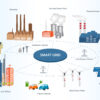
Experts confirm that current and future needs for electricity may soon exceed our global supply. New AI-driven data centers, electric vehicle charging stations, energy-intensive manufacturing operations, and a growing volume of internet connections are placing an increasing strain on outdated electric grids. This looming reality has since challenged utilities, grid operators, technologists, and regulators to reconcile existing electric capacity with rising demand.
It subsequently comes as no surprise that interest in renewable energy sources and related green technologies continues to grow. These solutions reduce carbon footprints, enhance global sustainability, and combat the effects of climate change.
Energy industry professionals have been addressing the disparity between electric supply and demand in various ways. Solutions include everything from increasing overall reliance on renewable energy sources to employing IoT-enabled automation devices to optimize electric distribution, reduce waste, and enhance overall electric efficiency, reliability, and performance.
A Green Energy Revolution
As utilities continue to integrate renewable energy sources into their mix, numerous engineering advancements are helping them meet energy supply targets and align with the United Nations’ Sustainable Development Goals for 2030.
In the solar power arena, scientists are working with a highly responsive family of crystalline compounds called perovskites to deliver more power from existing solar panel devices. Based on their ability to analyze massive amounts of real-world data, quantum computing and AI are also being harnessed to help achieve more efficient solar cell design. Thanks to these technological achievements, solar energy has become more affordable, with costs dropping by some 90% in the last decade. Based on this and other factors, the World Economic Forum predicts that solar power is on track to be the world’s dominant power source by 2050.
The Future of Sustainable Energy
Though wind turbines are currently a less prevalent source of renewable energy worldwide than solar power, advancements in these devices are similarly helping to make them more powerful, efficient, and accessible. An engineering team at England’s University of Birmingham recently used AI to test more than 2,000 different blade designs and “explore design possibilities beyond the scope of traditional human experimentation.” Their research led to the development of the ‘Birmingham Blade,’ an optimally shaped and weighted blade that’s up to seven times more efficient than existing designs and scheduled to be commercially available later this year. The computational powers of AI also accelerated the blade design process, reducing development time from years to weeks.
As a result of these and other breakthroughs in the green energy industry, renewable energy sources are growing globally. In 2024, all renewable energy sources combined – including wind, solar, hydropower, biomass, and geothermal – provided over 32% of the world’s electricity, nearly double the level that renewable sources represented 25 years earlier. In the U.S., the use of renewables accounted for over 24% of total electricity production in 2024, up 4% from 2023.
Smart Grid innovations
On top of the growing use of renewable energy sources, utilities are increasingly relying on intelligent “edge devices” to optimize electricity usage. This category includes the use of IoT-driven sensors and smart two-way meters to provide continuous monitoring and enable real-time insights into grid conditions. By tracking each user’s energy consumption patterns, these smart devices promote informed decision-making that allows utilities and users to optimize their energy usage and better integrate solar, wind, and other renewable sources into their energy portfolio. The additional ability to store this energy through battery energy storage systems (BESS) further helps to address supply shortfalls and stabilize/optimize the grid.
Transportation and Sustainability
Other technological developments are also making great strides towards reducing our global reliance on fossil fuels and combatting climate change. In the transportation sector, ongoing advancements in electric vehicle design, regenerative braking, and electric drive train technology continue to deliver instant power, greater efficiency, and zero tailpipe emissions relative to conventional internal combustion engines.
The world is responding in kind, with global sales of electric vehicles hitting a record 17 million in 2024 (a 25% growth over 2023 levels). This trend will continue to reduce the world’s carbon footprint. According to the European Environment Agency (EEA), electric vehicles emit 30% less greenhouse gases than traditional gasoline-fueled cars and their lifecycle emissions could decrease by at least 73% by 2050. In the U.S. alone, experts believe that the widespread use of EVs will lower the country’s CO2 pollution by two-thirds.
IEEE Climate Change eLearning Courses
As a globally recognized professional organization that plays a key role in shaping the fields of electrical engineering, electronics, and computer science, IEEE is committed to using its expertise and resources to foster technology for a sustainable climate.
To address growing concerns about climate change, IEEE offers a broad range of eLearning resources. These courses focus specifically on climate change and its impact across various industries, including:
- An Introduction to Sustainable Green Engineering: Part 1
- An Introduction to Sustainable Green Engineering: Part 2
- An Introduction to Windmill and Wind Turbine Design and Manufacturing Processes
- Engaging Consumers in the Smart Grid Marketplace
- Engineering Ethics: Guidance on Sustainability
- Engineering Solutions for a Sustainable Future
- Green Radio Techniques for Improved Wireless Basestation Design
- Introduction and Overview of Wind Turbine Design Challenges
- Introduction to Sustainable Green Engineering System Analysis and Design
- Smart Distribution Systems
- Strong Before Smart
- The Digitized Grid
- Transportation Electrification: Applications of Electric Drive Trains
- Transportation Electrification: Electric Machines in Electric Drive Trains
- Transportation Electrification: Introduction to Power Electronics in Electric Drive Trains
- Transportation Electrification: Power Semiconductors Used in Electric Drive Trains
- Wind Turbine Manufacturing, Assembly, Test and Maintenance Challenges
Explore these courses on the IEEE Learning Network, or request institutional access today.

Not so long ago, the perception of virtual and augmented reality technologies was confined to science fiction. Movies like Avatar, The Matrix, and Total Recall painted a picture of what could be possible. Today’s virtual reality (VR) and augmented reality (AR) technology is not quite as immersive as these examples, but it is advancing rapidly. Today, many businesses are recognizing the benefits of using augmented and virtual realities to improve their operations. AR and VR are now being used for everything from prototyping and design to marketing, customer service, training, and productivity.
While experts are split about the evolution of a truly immersive “metaverse,” they do expect that augmented and mixed-reality enhancements will become more useful in people’s daily lives. This is especially true when it comes to smart cities that commonly use Internet of Things (IoT) technologies. However, according to Jamie Cameron, director of digital solutions at building security company Johnson Controls, “connectivity and technology are not the end goal for smart cities—they are the means to improving the quality of life for city residents.” And with virtual and augmented reality technologies, smart cities could be much smarter.
Making Smart Cities More Sustainable
With the UN projecting 68% of the world population to live in urban areas by 2050, the combined carbon footprint of the world’s different cities is only set to grow. Connected communities have an advantage because they can use IoT technology to understand the problem and then help solve it.
Smart cities can collect a wealth of data by installing different sensors around the community. These sensors can range from measuring air quality, as used by the London Air Quality Network; or detecting leaking water pipes, as Vodafone has recently partnered with SES Water to do. After collecting the data, the smart cities can decide what to do with all that information. A model of a city known as a digital twin can be used to simulate how different policies may affect a city. It can also provide insight into progress being made towards sustainability targets.
Creating Safer Smart Cities
The infrastructure and systems needed to successfully collect, analyze, and transmit information across a city are complex and comprehensive. Smart cities may represent a better way to plan and manage urban living, but they also serve as attractive new targets for cyber criminals. Digital enhancement enhances digital risk. To keep a smart city running smoothly, governments need tech-enabled support desks to help resolve problems. Smart cities are built from data, but what information is collected, who has access to it, and how it may be used are all highly contentious areas impacting public trust.
Enhancing the Quality of Life in Smart Cities
To improve the quality of life in urban spaces, city councils, urban planners, and developers are exploring cutting-edge digital solutions that can potentially power smart cities. Augmented reality technology is a promising solution. AR works by overlaying digital information in real-world environments: all you need is a smartphone and AR can provide constant feedback within smart cities, allowing everyone to make informed decisions in their day-to-day life. AR can make urban spaces more people centered and improve urban mobility, public safety, public health, and tourism.
Keep up with AR/VR Technology
Information and communication technologies have made smart cities a reality. However, augmented reality and virtual reality technologies have shifted the smart city paradigm. Practical Applications of Virtual and Augmented Reality in Business and Society: The Case of Smart Cities will help keep you current with AR/VR technology.
Interested in the course? Visit the IEEE Learning Network.
Resources:
Anderson, Janna and Raine, Lee. (30 June 2022). The Metaverse in 2040. Pew Research Center.
Dumbell, Katherine. (18 July 2022). How smart technology can make cities more sustainable? Verdict.
Galil, Eran. (16 July 2022). Improving the customer experience with virtual and augmented reality. VentureBeat.
Imperial College London. (21 July 2022). About Londair. LondonAir.
Lee, Giacomo. (6 January 2022). Meet the tech CEO who survived a flood and built a digital twin of Earth. Verdict.
Manser, James. (5 June 2020). How IoT tech could save the UK three billion litres of water a day. Vodafone.
Milewa, Gergana. (12 September 2021). How Smart Cities Can Use Augmented Reality Technology. AR Post.
Rosenburg, Louis. (28 December 2021). Why AR, not VR, will be the heart of the metaverse. VentureBeat.
Open Access News. (15 November 2021). Connectivity: The fundamental ingredient of a successful smart city. Open Access Government.
Open Access News. (28 June 2022). The cities of the future are smart – but we must also make them secure. Open Access Government.
Today’s modern smart grid connects a variety of distributed energy resource assets to the power grid. This creates a diverse and disparate system, which both individuals and power companies can impact, with enormous benefits. Distributed energy collection assets (such as solar panels) are essential to increase the use of green energy, which helps the environment and can reduce costs. Furthermore, consumers have greater insight into their energy usage through modern smart grid technology, allowing them to better conserve energy.
However, an individual’s increased access to the grid can jeopardize the security of the entire system.
Consumers Putting the Smart Grid at Risk?
Because they are often installed and controlled by the consumer, distributed energy resources can put the power grid as a whole at risk. For example, consumers who do not properly secure their devices and/or networks are prime targets for attack. If there are enough compromised devices on a smart grid, bad actors can destabilize the power system and cause significant damage.
Efforts to Increase and Standardize Smart Grid Security
There are efforts underway to increase the security of the smart grid in order to harness the benefits while avoiding the security pitfalls. For example, the European Network for Cyber Security (ENCS) and the European Distribution System Operators’ Association (E.DSO) recently released suggested cyber-security requirements for smart meters (SM) and data concentrators (DC). These guidelines help network operators choose SMs and DCs that enhance security of the smart grid. By creating a consistent set of requirements, smart grids across Europe have a built-in baseline of security.
Planning a Secure Smart Grid
In order to avoid catastrophic results, today’s smart grid operator needs to have a plan in place that accounts for security.
As Ed Wood, CEO of Dispersive Networks, writes in SC Magazine, “Attack-resilient, secure virtual IP networks can be designed and rolled out, which will enable utilities to ensure a more secure overall grid. Advanced virtual networking software that offers the highest level of security is available today and can be integrated directly into Distributed Energy Resource assets, enabling them to ‘plug-n-play’ into ultra-resilient virtual cloud networks. Leveraging the processing and memory of these devices and the public Internet is essential to lowering costs.”
This tactic can help secure the smart grid while taking advantage of the environmental and cost-saving benefits of distributed energy resources.
Modernizing the Smart Grid from IEEE
Want to learn more about the smart grid? Check out Modernizing the Smart Grid, a new 4-course online learning program from IEEE.
One of the biggest frontiers in electrical engineering today is the development and implementation of smart grid technology. Fueled by the global demand for greener technologies and alternative fuels, environmentally-friendly smart grid technology can stimulate stagnated economies. It also has the potential to change the way power is delivered to electricity consumers around the world.
Modernizing the Smart Grid, now available on the IEEE Learning Network, is designed to get you and your team up to speed quickly on the latest smart grid technologies. Interested in bulk discounts for your organization? Contact us today, and we’ll put you in touch with an IEEE Account Specialist.
Resources:
Wood, Ed. (18 Jul 2019). How Securing DER Smart Grids Differs from Securing Traditional Energy Grids, and Why it Matters. SC Magazine.
SmartCitiesWorld News Team. (23 Jul 2019). Europe seeks to harmonise smart grid security requirements. SmartCitiesWorld.