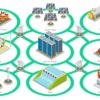
Smart grid technology is enabling the effective management and distribution of renewable energy sources such as solar, wind, and hydrogen. The smart grid connects a variety of distributed energy resource assets to the power grid. By leveraging the Internet of Things (IoT) to collect data on the smart grid, utilities are able to quickly detect and resolve service issues through continuous self-assessments. Because utilities no longer have to depend on customers to report outages, this self-healing capability is vital component of the smart grid.
Smart Grid Management of Renewable Energy
The relationship between the smart grid and renewable energy revolves around gathering data. For example, wind farms use mechanical gears that require each link to support multiple sensors. Each sensor is able to note current climate and environmental conditions. This information is then quickly sent though the grid to alert the utility of any issues, which improves both the quality of service and safety.
“You’ve got this story of this invisible, dangerous commodity that travels at the speed of light that we call electricity and for the last hundred-plus years most people could interact with it in only the most rudimentary ways,” says Mark Feasel, vice president of smart grid for Schneider Electric. Companies are now deploying much more advanced sensing devices. According to Feasel, some devices can continually capture information on electricity up to 60,000 times per second.
Semiconductor materials, such as silicon, are supporting the creation of green energy with smart grid technology. Due to their ability to hold millions of minuscule transistors, these materials have enabled IoT advancement. In turn, this advancement has allowed the smart grid to link up devices throughout the system, which ensures that the supply of energy is equal to the demand. It also keeps the current evenly distributed.
Smart grids equipped with parts made from semiconductor material reduce the usage of electricity. For example, electric vehicles can charge at night— a time when offices and homes are not typically using much electricity. Lights switches and furnaces can also automatically power on and off. In this way, energy usage becomes “smart” by not using more than what is needed.
Renewable Energy with Smart Grid Technology Initiatives
As smart grid technology becomes more promising, both local and federal governments are exploring potential grid improvements.
Thailand
By 2037, Thailand wants a third of its energy to be generated by renewable energy sources. This means that Thailand’s grid will need to be modernized to handle the varying levels of energy provided by renewable sources. Any modernization plans will also need to take the country’s growing demand for electric vehicles (EVs), which is predicted to grow in coming years.
“When we have more renewable energy, the grid will become more difficult to manage, and then we will need to give them more flexibility with the digital to make it smarter,” says Dr. Surat Tanterdtid, Chief of Enterprise Architecture of the Electricity Generating Authority of Thailand. Smart grid technology can help monitor and predict the supply of renewable energy into Thailand’s grid. This may allow the country to anticipate power outages and prepare accordingly.
New York
The New York State Energy Research and Development Authority is currently holding a competition in order to improve the state’s energy distribution. The Future Grid Challenge, which began in July, is part of a push to transition the state’s electric grid to renewable energy. A new statewide act includes requirements for a clean or carbon-free electricity sector by 2040 as well as an 85% greenhouse gas emissions drop by 2050.
The first round of funding will provide up to $6 million USD to projects that partner with Con Edison and Orange & Rockland Utilities. The goal of the competition is to improve data analytics, grid stability, and forecasting while reducing system losses.
Modernizing the Smart Grid
One of the biggest frontiers in electrical engineering today is the development and implementation of smart grid technology. Fueled by the global demand for greener technologies and alternative fuels, environmentally-friendly smart grid technology has the ability to stimulate stagnant economies as well as change the way power is delivered to electricity consumers around the world.
Modernizing the Smart Grid is a four-course program designed to get you and your team up to speed quickly on the latest smart grid technologies. Learn more about how your organization can benefit from this IEEE course program today!
Resources
Pilkington, Ben. (4 September 2019). The Role of Semiconductors in Clean Energy. AZO Clean Tech.
Castagna, Rich. (29 August 2019). How Smart Grid Technology Is Driving Renewable Energy. IoT World Today.
Clemens, Ashley. (12 September 2019). New York power grid challenge is part of larger state energy goals. Daily Orange.
Basu, Medha. (19 August 2019). Thailand will use smart grid to predict outages. GovInsider.
Basu, Medha. (16 September 2019). How Thailand will integrate renewables and EVs into the grid. GovInsider.
Engineering is just one of many professions that requires participation in continuing education programs in order to maintain a license. However, even if your particular line of work doesn’t require a professional certificate or license, voluntarily completing a continuing education program goes a long way toward demonstrating your commitment to improving your expertise in your field.
Enrolling in continuing education programs to earn certificates can benefit your career in at least eight ways.
- Stay current with new technology, laws, and regulations.
- Maintain your Professional Engineer license.
- Continue your professional development.
- Improve your skills.
- Prove professional competency.
- Stand out in professional networks.
- Bolster your resume.
- Build a little leverage during salary discussions with your employer.
Earn Your Certificate from IEEE
IEEE brings together some of the best and brightest minds in engineering to offer education programs based on the most relevant content to help you stay ahead in your field. Courses are mobile accessible, available 24/7, and provide CEUs/PDHs upon successful completion. Programs include:
- Artificial Intelligence and Ethics in Design
- English for Engineering
- Fundamentals of Autonomous Vehicle Technology
- Introduction to Blockchain Technology
- Introduction to Edge Computing
- The National Electrical Safety Code® (NESC®) Course Program
IEEE maintains an official registry of all certificates awarded, which makes it easier for you to account to state licensing boards. You can be proud to share your IEEE Certificate, a guarantee of educational quality.
To talk with an IEEE administrator and find a program that suits your needs, email us today at: eab-ceuadmin@ieee.org.
Resources
Ferriman, Justin. (23 Oct 2014). Understanding The Benefits of CEUs. LearnDash.
Ferriman, Justin. (5 Oct 2014). CEU vs PDH: What’s The Difference? LearnDash.